Pay in installments of $6.63 with
 ,
,
 and
and

Shipping Estimate
USA
- USA
- CAN
- USA
- CAN
Ships within 48 hours · Estimated delivery Jun 28 - Jul 3
 Promo Codes Available:
For Your Every Summer RSVP, with Code: SUMMER15
Description
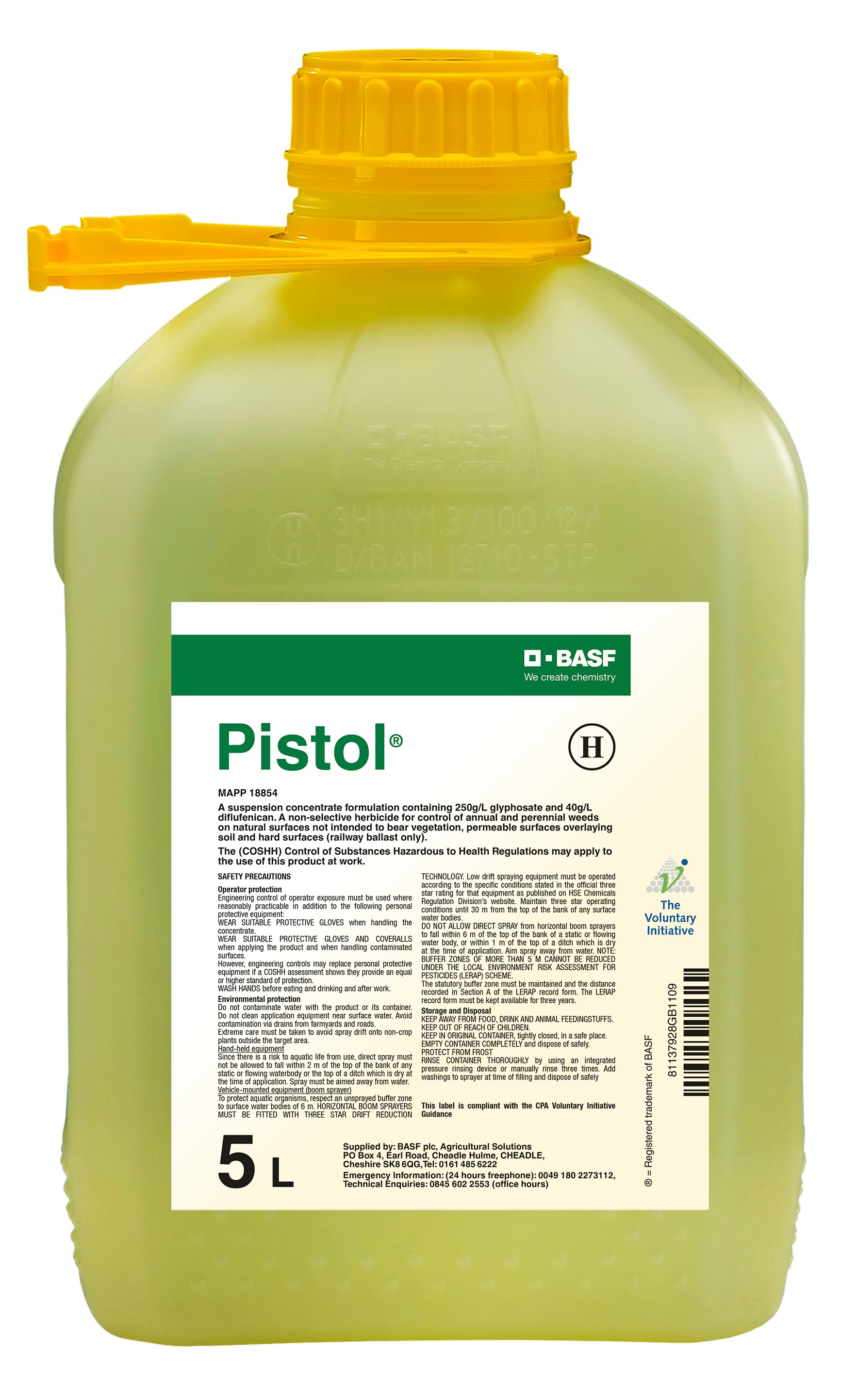
pistol herbicide label Pistol Herbicide | Total Weed KillersPistol MAPP no. 18854 Active Ingredients: 40g l diflufenican and 250g l glyphosate. Packaging may vary Product Overview Product Type Herbicide Product Name Pistol MAPP No. 18854 Active Substances Diflufenican and glyphosate Formulation Suspension concentrate Areas of Use Natural surfaces not intended to bear vegetation, permeable surfaces overlying soil, hard surfaces (railway ballast only) Amateur Professional Professional Application Window Jan Feb
Pistol® - MAPP no. 18854
Active Ingredients: 40g/l diflufenican and 250g/l glyphosate.
Packaging may vary
| Product Overview | |
|---|---|
| Product Type | Herbicide |
| Product Name | Pistol® |
| MAPP No. | 18854 |
| Active Substances | Diflufenican and glyphosate |
| Formulation | Suspension concentrate |
| Areas of Use | Natural surfaces not intended to bear vegetation, permeable surfaces overlying soil, hard surfaces (railway ballast only) |
| Amateur/Professional | Professional |
| Application Window | |||||||||||
|---|---|---|---|---|---|---|---|---|---|---|---|
| Jan | Feb | Mar | Apr | May | Jun | Jul | Aug | Sep | Oct | Nov | Dec |
| Weeds Controlled |
|---|
Pistol® is a fast acting and effective total herbicide for pre- and post-emergent application, which both controls existing broad-leaved and grass weeds and provides ongoing residual activity to prevent new weeds from germinating.
It controls a broad spectrum of annual and perennial broad-leaved weeds on natural surfaces not intended to bear vegetation, permeable surfaces overlying soil, and hard surfaces (railway ballast only). It can be applied once per year at a rate of 4.5l/ha.
Pistol® is rainfast within one hour, increasing potential spraying opportunities. In addition, the residual activity means that herbicide application frequency is reduced as surfaces can stay weed free for up to six months.
The systemic action of glyphosate means that it is translocated throughout the whole plant, proving effective control of both seedlings and established weeds. Diflufenican is a residual active substance which sticks to the surfaces forming a barrier which prevents weed germination.
The 5 litre bottle is sufficient to treat 1.1ha.
Target Species
Pistol® gives post-emergence control of both seedlings and established weeds as well as pre-emergence control by forming a surface barrier that prevents germination.
A selection of the plant species that are controlled by Pistol® are listed below (please read the label for the full species list):
| Grasses | Annual Herbs | Perennial Herbs | Woody Plants |
|---|---|---|---|
| Annual meadow-grass (Poa annua) Couch grass (Agropyron repens) Rough stalked meadow-grass (Poa trivialis) |
Annual nettle (Urticaria urens) Canadian fleabane (Erigeron canadensis) Chickweed (Stellaria media) Common groundsel (Senecio vulgaris) Fat hen (Chenopodium album) Mayweed (Tripleurospermum inodorum & Matricaria recutita) Knotgrasses (Polygonum spp) Red dead nettle (Lamium purpureum) |
Buttercup (Ranunculus spp) Mouse-eared chickweed (Cerastium fontanum) Common daisy (Bellis perennis) Ragwort (Senecio jacobaea) Cranesbill (Geranium spp) *Dandelion (Taraxacum officinale) *Dock (Rumex spp) Field forget-me-knot (Myosotis arvensis) Perennial thistle (Cirsium spp) Plantain (Plantagao spp) Sow thistle (Sonchus spp) Speedwell (Veronica spp) Willowherb (Epilobium spp) |
Cinquefoil (Potentilla fruticosa) |
*Perennial weeds such as dandelions and docks emerging from established root-stocks after application will not be controlled.
Instructions for use
Where to use
For use on:
- Natural surfaces not intended to bear vegetation - Areas of soil or natural outcroppings of rock that are not intended to bear vegetation
- Permeable surfaces overlying soil - Any man-made permeable surface (excluding railway ballast) that overlies soil and is not intended to bear vegetation
- Hard surfaces (railway ballast only) - Any railway ballast impermeable surface that is not intended to bear vegetation
When to use
Pistol® can be applied from February until the end of July when weeds are actively growing and have not begun the process of natural dieback.
How to use
| Maximum Treatments | Pack Coverage | Application Method | Application Rate | Water Volume | Spray Quality |
|---|---|---|---|---|---|
| 1 per annum | 1.1 ha | Conventional knapsack sprayer | 4.5l/ha | 200-500 l/ha | Coarse |
| Vehicle mounted sprayer | 4.5l/ha | 200-500 l/ha | Three star drift reduction nozzles | ||
| Knapsack with CDA applicator | 4.5l/ha | 200-500 l/ha | Volume Median Diameter at least 300 microns |
- Add half the required water or carrier to the spray tank
- Start gentle agitation and add the required amount of Pistol® to the spray tank
- Mix and top-up the spray tank with water to the required level
- Use immediately
- For maximum persistence do not cultivate or rake the area following application
Additional Information
- Do not use if an impermeable membrane lies between the porous surface and the soil
- Keep an unsprayed buffer zone of 6m around surface water bodies when using vehicle-mounted spraying equipment (2m for handheld equipment)
- Do not apply when plants are growing under stress conditions such as drought or water-logging or in windy conditions
- Avoid drift onto non-target plants
- Allow 6 months before sowing or planting any subsequent crops and plough or dig the soil thoroughly to reduce any risk of damage to the plants
- Heavy rain following application can wash the herbicide onto sensitive areas
- Pre-emergence activity is lower when the soil organic matter content is greater than 10% or where organic matter has built up on the surface
- Only use a carrier when applying through a CDA applicator
- Do not apply over drains or in drainage channels, gullies or similar structures for moving water
Active substances
Diflufenican
Bio-Chemical Mode of Action: Diflufenican belongs to the inhibition of pigment synthesis group of herbicides.
Pigment inhibitors work by interfering with pigment production, leaving the chlorophyll unprotected from sunlight. As a result, the cell contents are destroyed rapidly.
Mobility: Diflufenican is a residual herbicide with xylem mobile activity which means that as susceptible plants come into contact with the active substance, it is absorbed through the leaves and roots then moves upwards through the plant within the xylem (water conducting tissues).
Application timing: Pigment inhibitors should be applied pre– or early post-emergence. They are most effective when target plants are small.
Glyphosate
Bio-Chemical Mode of Action: Glyphosate belongs to the Inhibition of Enolpyruvyl Shikimate Phosphate Synthase (ESPS) group of herbicides.
ESPS herbicides work by shutting down the shikimate pathway which is used in the production of the proteins it needs to grow and survive.
Mobility: Glyphosate is a systemic penetrant which means that the active substance can be translocated downwards through the plant within the phloem (sugar conducting tissues) and upwards through the plant within the xylem (water conducting tissues).
Application timing: ESPS herbicides are best applied when the weeds are actively growing. They are generally more effective when target plants are younger and in their vegetative phases.
Resistance: As of 2018, 38 weed species distributed across 37 countries and in 34 different crop and 6 non-crop situations had been identified.
Shipping Notes
- Free Standard Shipping on $100+ Orders to the USA.
- Except Preorder products are shipped in 48 hours.
- Delivery to the USA:
- Standard Shipping : 3-10 business days
- If time is of the essence, please consider selecting expedited delivery for faster service.
Exchange/Return Notes
- We offer a 30-day return/exchange service after receiving.
- Final sale items are not eligible for returns or exchanges.
- To process your return/exchange, please contact us at [email protected]
- Please click here for more details>>> Return & Exchange Policy